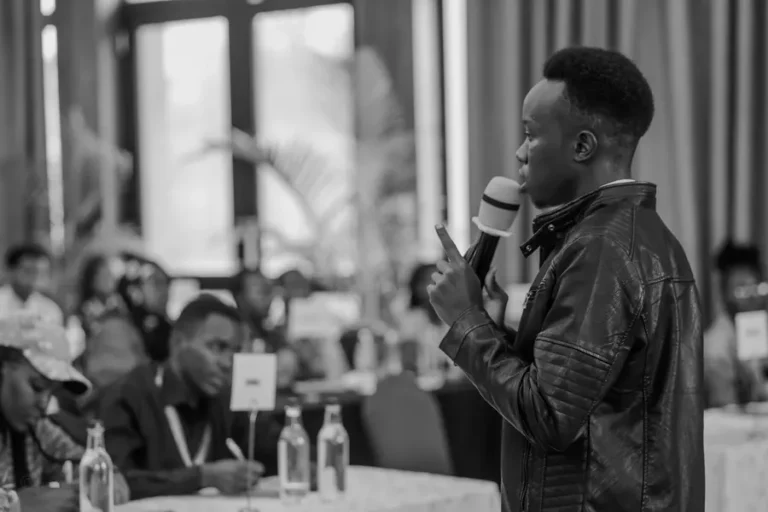
There’s a moment I’ve witnessed hundreds of times from the side of a stage.
A senior leader walks to the lectern. They unfold a speech that clearly took the comms team a week to write. It’s well-researched. The sentences are elegant. The arguments are sound.
Ninety seconds in, the audience is gone. Not physically. They’re still in their seats. But their eyes have drifted to their phones, the programme, the coffee station.
The speech wasn’t bad. It was written for the eye. And audiences listen with their ears.
Why spoken words work differently
When you read, you’re in control. You can slow down, re-read a sentence, glance back at the previous paragraph, skim a list.
When you listen, you have one chance. The words arrive at the speaker’s pace, then they’re gone. If a sentence is long, nested and full of clauses, the listener loses the thread before the verb arrives.
Writing for the ear means accepting that your listener has no rewind button.
1. Short sentences carry further
Look at this:
“Given the significant challenges posed by increasingly erratic rainfall patterns across the arid and semi-arid lands, which constitute a substantial proportion of Kenya’s land mass, it is imperative that stakeholders collaborate to scale up community-based adaptation interventions.”
Now say it out loud. You ran out of breath, didn’t you?
Try this instead:
“Most of Kenya is dry land. The rains there are getting harder to predict. Communities are already adapting. Our job is to help them do it faster.”
Four short sentences. Same meaning. You can actually hear it.
2. Repetition is a feature, not a bug
On paper, repeating a point looks lazy. In speech, it’s essential. Listeners drift. Repetition brings them back.
The old rule still works: tell them what you’re going to say, say it, then tell them what you said.
Great speakers repeat key phrases deliberately. Think of how a memorable refrain in a speech returns again and again, building power each time.
3. Give the listener a map
Signposts help people follow:
- “I want to leave you with three ideas.”
- “First…”
- “Here’s where it gets interesting.”
- “So what does this mean for us?”
These feel unnecessary in writing. Spoken, they’re lifelines.
4. Make pictures, not abstractions
Abstract language evaporates. Concrete images stick.
“Water scarcity affects livelihoods in pastoralist communities” fades instantly.
“Picture a mother in Marsabit setting off before dawn, because the nearest water point is now hours away” stays with people.
Whenever you write a big abstract word like resilience, livelihoods, capacity or stakeholders, ask: what does this actually look like? Then describe that instead.
5. Banish the acronyms
NDC. GGA. NCQG. FRLD. BBNJ. Every acronym is a speed bump. Listeners can’t stop to look it up. Spell it out, or better, replace it with plain language. “Money to help countries cope with floods and droughts” works better than “adaptation finance” for most audiences.
6. Write for the voice that will speak it
A speech must sound like the person delivering it. Before writing, listen to how they talk. What phrases do they use? Are they formal or warm? Funny or serious? Fast or measured?
Then write in their voice and rehearse with them. Cut any word they stumble on.
7. Mark it up like a professional
In radio and voice-over, scripts are marked for delivery. I do it for every speech and script:
- A slash / for a short pause.
- A double slash // for a long pause.
- Underlines for emphasis.
- Breath marks before long sentences.
It feels technical. It transforms delivery.
8. Read it aloud. Then read it aloud again.
This is the single most useful habit. Read every draft aloud, at speaking pace, standing up. You’ll instantly hear the sentences that are too long, the transitions that don’t flow and the words that trip your tongue.
Try this today
Take the opening paragraph of your organisation’s last speech. Read it aloud. Then rewrite it using short sentences, one concrete image and no acronyms. Read it again.
You’ll hear the difference immediately. So will your audience.
As an MC, moderator and voice-over artist, writing for the ear is at the centre of my work, and it’s one of the skills I’m teaching through ImpactComms. Need a speech written or a speaker coached? See my speaking work or get in touch.
Frequently asked questions
What does “writing for the ear” mean?
Writing text meant to be heard rather than read: short sentences, repetition, signposts, rhythm and concrete images.
How do I make a speech easier to follow?
Signpost your structure, repeat the key point, avoid acronyms and read the script aloud before delivering it.
Cover photo: Jacob Hodgson on Unsplash

Impact communications strategist and climate storyteller. Managing Director of Reznick Communications and Founder & CEO of WeAreTELL.