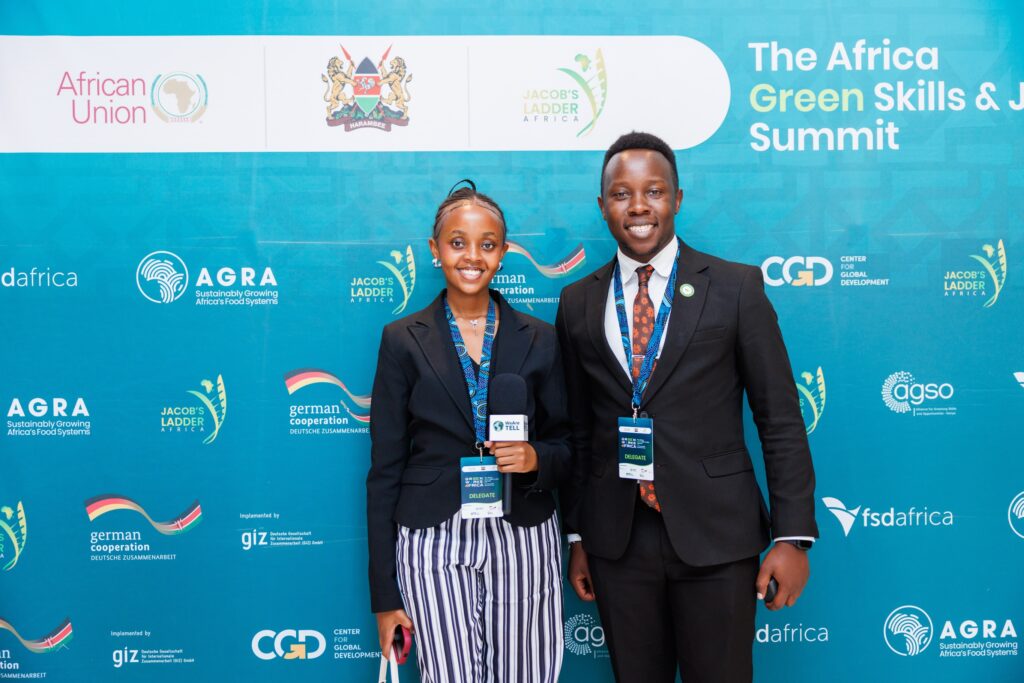
Ask a room of young Kenyans what they think about climate change, and you’ll get thoughtful answers. Droughts. Floods. Heat. Unpredictable seasons.
Ask the same room what keeps them up at night, and the answer changes. Jobs. Rent. Fees. Whether there’s a future that pays.
For years, much of the climate conversation in Africa has struggled to bridge those two answers. Mid-August in Nairobi, at the GreenWorks4Africa Forum 2026, convened by Jacob’s Ladder Africa, that bridge was the whole point.
WeAreTELL was there documenting the conversations. Here’s what I took away.
The numbers behind the urgency
Kenya is a young country. More than 70% of the population is under 35. Every year, hundreds of thousands of young people finish school, college or university and go looking for work in an economy that doesn’t create enough formal jobs to absorb them.
At the same time, the shift to a low-carbon, climate-resilient economy is creating demand for skills that barely existed a generation ago: solar installation and maintenance, e-mobility mechanics, sustainable agriculture, waste and recycling, water management, green construction, restoration and conservation.
Put those two realities side by side and you see the opportunity. If the green transition is designed with young people at its centre, it could become one of the largest employment engines on the continent.
What a green job actually looks like
“Green jobs” can sound like a slogan. On the ground, it’s very specific.
It’s the young technician who installs solar home systems in rural homes and comes back when something breaks. It’s the electric motorbike mechanic in a Nairobi garage. It’s the recycler who sorts, cleans and sells plastics and metals. It’s the agroforestry farmer whose trees protect the soil and produce fruit. It’s the community ranger. It’s the person training others to do all of the above.
None of these jobs require a pitch deck. They require skills, tools, access to finance and a market.
Three things I heard again and again
The skills gap is real. Employers in solar, e-mobility and circular economy businesses struggle to find people with the right training. Meanwhile, young people with qualifications struggle to find work. The problem isn’t a lack of talent. It’s a mismatch between what’s taught and what’s needed.
“Green” must also mean decent. A lot of the work that keeps waste out of rivers and food on tables is informal, low-paid and unsafe. A waste picker sorting recyclables with bare hands on a dumpsite is technically in a green job. That’s not the future anyone should aspire to. Green jobs have to be fair jobs.
Young people want pathways, not just inspiration. Motivational talks are fine. What young people asked for, over and over, was concrete: apprenticeships, certification, mentorship, starter kits, links to employers and access to finance.
Why this is a storytelling opportunity
For years, the dominant climate story told about Africa has been a story of threat. It’s true, and it matters. But on its own, it doesn’t move most people to act. It can make them feel powerless.
The green jobs story flips the frame. Climate action becomes something that puts money in pockets, food on tables and dignity in daily life. It’s a story that resonates with parents worried about their children’s future, politicians worried about unemployment and young people looking for a way in.
If you work in climate communication in Africa, this is one of the most powerful narratives you have.
How to tell green jobs stories that land
Feature real workers, by name, with consent. Not “beneficiaries”. People with skills, ambitions and opinions.
Show the pathway. How did they get the skills? What did it cost? What do they earn now? Specifics make it believable and replicable.
Be honest about the hard parts. Low pay in some sectors, unsafe conditions, the difficulty of accessing finance. Honesty builds trust.
Connect to policy. What would it take to multiply these jobs? Training funds? Procurement? Better regulation of informal work? Stories should point somewhere.
For organisations running green skills programmes
Your stories are your best advocacy. A well-documented journey from training to employment is worth more to a funder or a ministry than a page of output numbers. Invest in documenting it properly and ethically.
Thank you to Jacob’s Ladder Africa and all the partners for convening this conversation. See photos from the forum in the gallery and the event on my events page. For more on the bigger policy picture, read my explainer on the just transition.
Frequently asked questions
What is GreenWorks4Africa?
Africa’s green skills and jobs forum, convened by Jacob’s Ladder Africa. The 2026 forum took place in Nairobi from 11 to 13 August.
What are green jobs?
Decent work that contributes to a low-carbon, climate-resilient economy, in areas such as renewable energy, sustainable agriculture, waste management, water and conservation.
Cover photo: Blair Reznick / WeAreTELL archive

Impact communications strategist and climate storyteller. Managing Director of Reznick Communications and Founder & CEO of WeAreTELL.