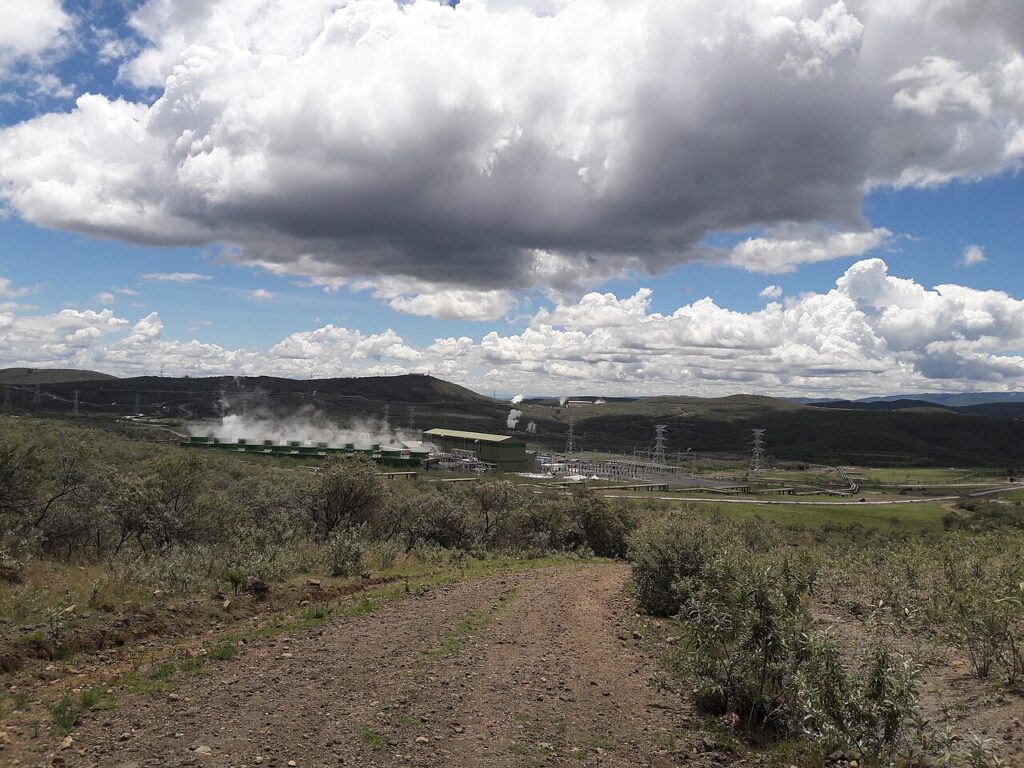
Drive north-west from Nairobi into the Rift Valley, past Naivasha, toward Hell’s Gate National Park, and you’ll eventually see them: plumes of white steam rising from the ground against the cliffs.
That steam is Olkaria, one of the largest geothermal power complexes in Africa. Deep beneath the Rift Valley, magma heats underground water. Wells tap the steam, turbines spin and electricity flows into the national grid.
It’s one of the reasons Kenya is a global outlier. Most of the country’s electricity comes from renewable sources: geothermal from the Rift Valley, hydropower from the Tana River dams, wind from the vast Lake Turkana Wind Power project in the north, and growing solar.
Few countries on Earth can say that. And yet it’s a story we don’t tell loudly enough.
Earth Day 2025: “Our Power, Our Planet”
Today, 22 April 2025, is Earth Day, and this year’s theme is “Our Power, Our Planet”: a global call to triple renewable electricity generation by 2030. It echoes the pledge countries made at COP28 in Dubai in 2023.
Tripling is a big number. The question for communicators is how to make it feel like something other than a big number.
Energy is the most personal climate story
Few climate topics touch daily life as directly as energy.
Energy is the light a child studies by. The fridge that keeps a rural pharmacy’s vaccines cold. The pump that lifts water to a farm. The phone charger that keeps a small business connected. The difference between a clinic that can deliver babies at night and one that can’t.
In much of Africa, energy access is still the headline. Hundreds of millions of people on the continent live without reliable electricity, and many more depend on firewood and charcoal for cooking. That makes clean energy one of the most hopeful climate stories we have, because it’s also a development story, a health story and a jobs story.
Three mistakes I see constantly
1. Leading with megawatts. “A 50MW solar plant was commissioned today” is a press release. “A school in Garissa now runs evening classes” is a story. Lead with the life, follow with the megawatts.
2. Forgetting the people who make it work. Solar technicians climbing onto roofs. Mini-grid operators in remote towns. The women running pay-as-you-go agent networks door to door. Engineers at Olkaria. They’re the protagonists. Feature them by name, with consent.
3. Ignoring the trade-offs. Large energy projects raise real questions: land use, community consent, mineral supply chains, affordability. Audiences trust you more when you acknowledge challenges. Honest stories travel further than glossy ones.
A simple framework: Before, Switch, After
Here’s a structure I use for clean energy stories:
Before: What did life look like? Kerosene fumes. Expensive diesel. Dark evenings. A business that closed at sunset.
Switch: What changed, and who made it happen?
After: What’s possible now? More income, safer homes, more study time, more dignity.
Then zoom out with one data point that shows scale. Keep the big numbers for the end, not the opening.
Kenya’s quiet advantage
Kenya’s renewable electricity story gives Kenyan voices real authority in global climate conversations. When a Kenyan speaker talks about the energy transition, they’re not talking theory. They’re talking about something their country has already done.
That’s a narrative asset. Use it.
Your Earth Day checklist
- Pick one person, one place, one change.
- Use a strong photo of a human, not a solar panel.
- Close with one action your audience can take.
- Repurpose: one good interview can become a blog post, three social posts and a short video.
If you’re hosting an Earth Day or energy event and need someone who can make energy policy feel human on stage, I’d love to hear about it. The storytelling principles I use are the same ones I’m building into my teaching at ImpactComms.
Frequently asked questions
What was the Earth Day 2025 theme?
“Our Power, Our Planet”, a call to triple global renewable electricity generation by 2030.
How do you tell a clean energy story people care about?
Start with a person and a change in their daily life, such as light, income or health, then add one data point for scale. Lead with people, not megawatts.
Cover photo: Macabe5387 via Wikimedia Commons (CC BY-SA 4.0)

Impact communications strategist and climate storyteller. Managing Director of Reznick Communications and Founder & CEO of WeAreTELL.