In the early hours of 29 April 2024, a wall of water tore through Kamuchiri village near Mai Mahiu, in Nakuru County. Weeks of relentless rain had swollen the rivers of the Rift Valley, and a blocked culvert on a railway embankment gave way. Families were asleep. Dozens of people died.
What makes moments like this so painful is that the rains themselves were not a surprise. Kenya’s meteorologists had warned for weeks that the March to May long rains would be heavy. By the time the season was over, nearly 300 people had died and hundreds of thousands had been displaced across the country.
The forecast reached the newsrooms. It didn’t always reach the people who needed it, in a form they could act on, in time.
That gap, between knowing and doing, is the most important story in disaster risk reduction. Today, on the International Day for Disaster Risk Reduction, let’s talk about it.
The most cost-effective thing we can do
Early warning systems are one of the best investments in climate adaptation. The Global Commission on Adaptation found that a warning just 24 hours before a storm or heatwave can cut the resulting damage by 30%.
That’s why, in March 2022, UN Secretary-General António Guterres launched Early Warnings for All, with a bold goal: every person on Earth protected by early warning systems by the end of 2027.
We’re now a year away from that deadline. According to WMO reporting, only around half of the world’s countries say they have multi-hazard early warning systems, and coverage is weakest in least developed countries and small island states, exactly the places that need them most.
A warning is a chain, and chains break at the weakest link
The UN describes early warning as four connected pillars:
- Knowing the risk: which communities are exposed to which hazards.
- Detecting and forecasting: the satellites, radars, gauges and models.
- Communicating the warning: getting the message to people.
- Preparedness to respond: people knowing what to do, and being able to do it.
Over the last two decades, pillar two has improved enormously. Forecasts are sharper and longer-range than ever.
The chain usually breaks at pillar three and four. And that is a communication problem.
Why warnings fail
Picture what a typical warning looks like by the time it reaches a village.
It might be a press statement in English, full of terms like “enhanced rainfall” and “probability of above-normal conditions”. It might be a radio bulletin at a time when farmers are in the fields. It might be a WhatsApp forward with no source, competing with a dozen rumours.
Now ask yourself: would that make you leave your home in the middle of the night?
Warnings fail when they are:
- Late: they arrive after the window to act.
- Unclear: jargon, probabilities without explanation, the wrong language.
- Not actionable: they describe the hazard but not what to do.
- Untrusted: they come from a source people don’t know or believe.
- Unequal: they don’t reach women, older people, people with disabilities or remote households.
What a good warning sounds like
Compare these two messages.
“The Kenya Meteorological Department forecasts enhanced rainfall over the Rift Valley region with a high probability of flooding in low-lying areas.”
“Heavy rain is expected tonight and tomorrow in Mai Mahiu. If you live near the river or below the railway embankment, move to higher ground before dark. The chief’s office is open as a shelter.”
The first is accurate. The second saves lives. It’s local, specific, timed and tells people exactly what to do and where to go.
The messengers matter as much as the message
In many communities, the most effective warning system isn’t an app. It’s a person.
The chief who calls a baraza. The community radio presenter who explains the forecast in Kiswahili or Kalenjin during the morning show. The church elder. The health volunteer who goes door to door. The youth group with a loudspeaker on a motorbike.
People act on warnings from people they trust. Any early warning strategy that ignores local messengers is building pillar three on sand.
What climate communicators can do
This is where our profession has a real role. Not as cheerleaders, but as translators and connectors.
- Partner with meteorological services to turn technical forecasts into plain-language, local messages.
- Use the channels people actually use: community radio, SMS, WhatsApp voice notes, barazas, places of worship.
- Work in local languages. A warning in a language people don’t fully understand is half a warning.
- Train local champions to relay and explain warnings.
- Tell the success stories. When a community moves to safety because of a warning, that story builds trust for the next one.
The deadline is close
Early Warnings for All set 2027 as its target. Whether the world gets there will depend on money, technology and political will. But it will also depend on something simpler: whether a mother in a flood-prone settlement hears a warning she understands, from someone she trusts, in time to wake her children and leave.
That last mile is where lives are saved. It’s also where storytellers, journalists and communicators can make the biggest difference.
Disaster risk communication sits at the heart of climate justice. Read more climate justice articles, or invite me to moderate your disaster risk reduction dialogue.
Frequently asked questions
What is Early Warnings for All?
A UN initiative launched in 2022 aiming for everyone on Earth to be protected by early warning systems by the end of 2027.
Why do early warnings fail?
Often because warnings don’t reach people in time, aren’t understood, aren’t trusted or don’t say what to do. Communication is the last mile.
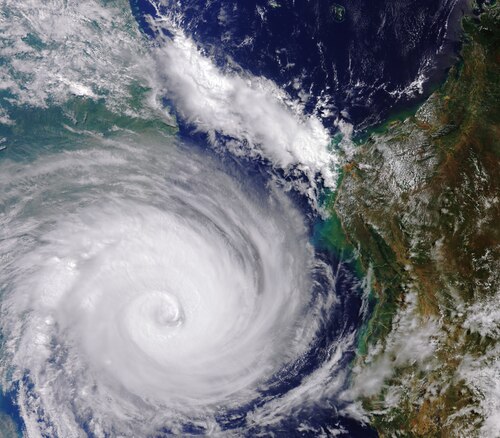
Cover photo: European Space Agency via Wikimedia Commons (CC BY-SA 3.0 igo)

Impact communications strategist and climate storyteller. Managing Director of Reznick Communications and Founder & CEO of WeAreTELL.