Some climate summits are won in the opening speeches. Most are won, or lost, in what happens after the speeches end, when the lights in the plenary hall dim and negotiators start fighting over single words in a draft text.
Antalya has now reached that point. The first week of COP31 is over. On Monday afternoon the first draft of the summit’s main political decision appeared, and ministers flew in on Tuesday for the high-level segment. Officially, everything has to be agreed by Friday 20 November.
I’ve spent the week reading every bulletin, briefing and draft I could find. In my week-one wrap I covered the headline money and the shared presidency. This piece goes deeper, into the parts of week one that will decide whether Antalya delivers for Africa or becomes another COP of nice announcements.
A summit of contrasts
COP31 is a big gathering. Carbon Brief reported around 92,000 registered participants, including about 14,000 host-country guests. The United States sent no official delegation.
UN Secretary-General António Guterres told leaders it was “make or bake time”. He meant that the gap between promises and delivery can’t keep growing.
Behind the speeches, the numbers were sobering. A Carbon Brief analysis found that public climate finance pledged for the coming years is roughly 70% below 2025 levels. Barbados Prime Minister Mia Mottley summed it up in four words: “pledges are not payments”.
The money announced in Antalya is real. So is the money that has quietly disappeared.
The draft that landed on Monday
The biggest moment of the transition from week one to week two was the first draft of the “cover decision”, the overarching political text that ties the summit’s threads together.
According to Climate Home News and Reuters, the draft runs to about 18 pages and draws on 45 submissions representing more than 160 governments. It includes:
- A global electrification goal, sometimes called “35 by 35”.
- Language on carbon capture and storage.
- A call for IPCC reports to be ready before the next global stocktake.
- An option for adaptation finance of US$120 billion a year by 2035.
- Two options on fossil fuels: the “transitioning away” wording agreed at COP28 in Dubai, or a stronger “phase out”. Either could still be deleted.
Chris Bowen, Australia’s minister who is leading the negotiations under COP31’s shared presidency with Türkiye, was blunt: “The first draft will look very different to the final draft.” Analysts described the approach as putting everything on the table and letting governments fight over the trade-offs.
Where the fault lines are
By the end of the first week, the main battle lines were clear.
1. Fossil fuels and new targets
At a stocktaking session on Saturday, the Arab Group and the Like-Minded Developing Countries opposed adding new sectoral targets to the cover text. Saudi Arabia rejected references to Brazil’s voluntary roadmap for transitioning away from fossil fuels, which Brazil formally presented in Antalya. India objected to citing science produced outside the UN process, including a UNEP report on overshoot.
2. Climate finance: who pays, and how much?
In talks on a new climate finance work programme, the EU wants a broad scope that covers private finance, development banks and contributions from wealthier developing countries. The G77 and China want the focus kept on Article 9.1 of the Paris Agreement, which sets out developed countries’ obligation to provide finance. The Climate Action Network reported that the G77 and China rejected the latest text as too weak.
3. Adaptation
For Africa, this matters most. Developing countries want at least US$120 billion a year in adaptation finance by 2035, building on the call at COP30 in Belém to at least triple it. According to CAN, the EU, Japan and Norway objected to references to tripling, and Australia opposed including it. That’s a significant position from the country steering the negotiations.
4. Loss and damage
CAN reported that 119 countries have requested about US$2.8 billion from the Fund for responding to Loss and Damage, which has received only about US$600 million. One draft option would give the Fund “no guidance at all”. (New to the topic? Read loss and damage explained simply.)
5. Just transition and mitigation
CAN described the first just transition text as offering little more than a website, an annual meeting and a compilation of reports. On the Mitigation Work Programme, the African Group, the Arab Group and Malaysia want it extended to 2030, while the EU and Mongolia proposed 2040.
What this means for Africa
Strip away the jargon and Africa’s interests in Antalya are simple:
- Adaptation money that actually arrives. African countries are paying for climate impacts they did nothing to cause. A number in the final text, with a credible path to deliver it, matters more than any announcement.
- Energy access, not just electrification targets. Around 600 million Africans still lack electricity. A global electrification goal is only meaningful if it includes them.
- A funded loss and damage fund. Requests are already several times larger than the money available.
- A just transition with substance. Africa’s critical minerals, workers and communities need more than a website. (See Africa’s critical minerals story.)
Africa doesn’t need more pledges. It needs payments, plans and accountability.
A note on the noise
Week one also produced plenty of initiatives: an Antalya AI pledge, a green industrialisation compact, forest finance announcements and more. Some are promising. But reports of how many countries have signed on vary between outlets, and several are voluntary with no clear accountability.
As communicators, our job is to separate signal from noise: to ask who signed, what it commits them to, and how we’ll know if it happened.
What to watch in week two
- Whether the fossil fuel language survives, and which version.
- Whether a number for adaptation finance stays in the text.
- Whether the loss and damage fund gets real guidance.
- Whether the climate finance work programme focuses on what developed countries owe.
- Whether the summit ends on Friday or, as COPs often do, runs into the weekend.
The communicator’s takeaway
If you’re telling the COP31 story to your audiences this week, don’t just repeat the biggest dollar figures. Show the gap between what is announced and what is delivered. Name the specific decisions, explain them in plain language, and connect them to real places: a farmer in Makueni, a fishing family in Kilifi, a girl in Turkana who still studies by torchlight.
That’s how a negotiation in Antalya becomes a story people in Nairobi care about. If you need help translating COP outcomes for your audiences, get in touch, or learn to do it yourself through ImpactComms. Explore more of my climate articles.
Frequently asked questions
What happened in the first week of COP31?
Leaders gave speeches and made announcements while negotiators worked on more than 100 agenda items. The week ended with sharp divisions over fossil fuels, climate finance, adaptation, loss and damage and the just transition, followed by a first draft of the main cover decision.
What is in the COP31 draft cover decision?
The first draft, published on 16 November, includes a global electrification goal, an option for US$120 billion a year in adaptation finance by 2035, and two options on fossil fuels: “transitioning away” or “phase out”. Negotiators expect major changes before the final version.
Why does COP31 matter for Africa?
African countries need adaptation finance, a funded loss and damage fund, energy access for around 600 million people without electricity, and a just transition that benefits workers and communities.
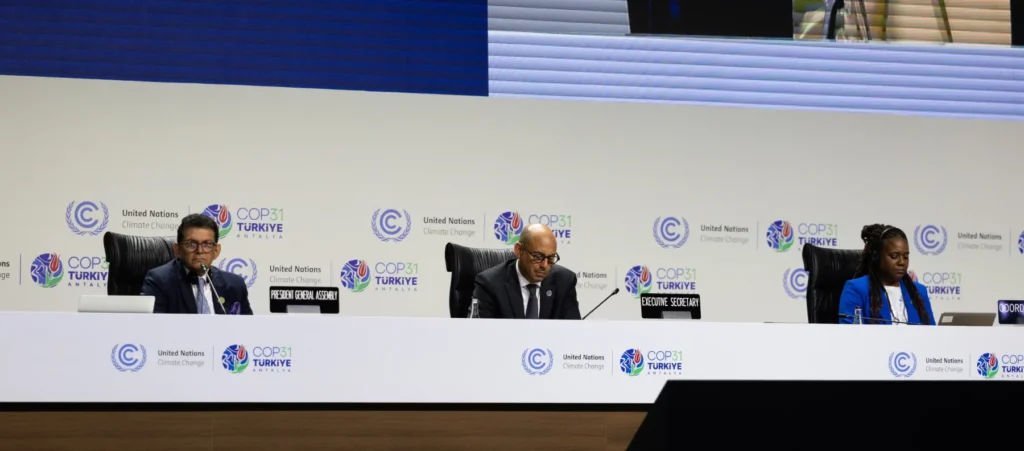
Cover photo: High-Level Opening Plenary at COP31, Antalya, 11 November 2026. © UN Climate Change – Kubilay Ciftci, via UNFCCC Flickr (CC BY-NC-SA 4.0, cropped).
Impact communications strategist and climate storyteller. Managing Director of Reznick Communications and Founder & CEO of WeAreTELL.