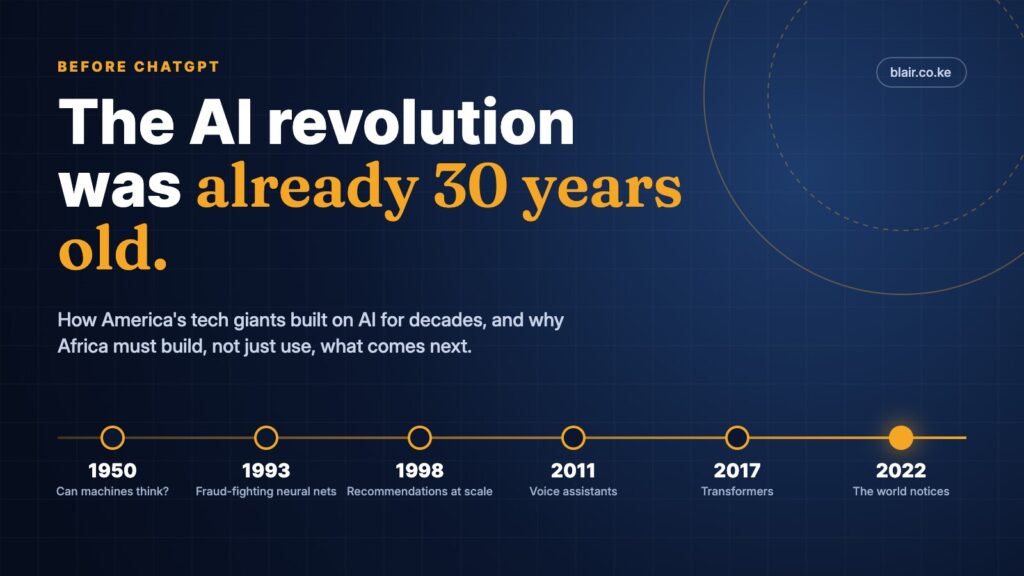
In November 2022, the world met ChatGPT and decided the AI age had begun. But Visa had been using neural networks to catch fraud since 1993. Amazon had been reading your shopping mind since 1998. So who really started the AI revolution, and why did so many of us arrive three decades late?
The Technology We Thought Was New
Think back. When did you first really hear about Artificial Intelligence?
For most people across Africa, the answer sits somewhere between late 2022 and 2023. Maybe a friend shared a screenshot of ChatGPT writing a poem. Maybe a colleague drafted a perfect email in ten seconds. Maybe a student in your family suddenly finished assignments a little too fast. Or maybe you were a business owner who discovered you could produce a month of marketing content before lunch.
Overnight, everyone was talking about AI. ChatGPT became a household name. Claude, Gemini and a wave of other platforms followed. Boardrooms in Nairobi, Lagos and Johannesburg started asking the same question: how do we use this?
It felt as though the world had just woken up to a brand-new invention.
It hadn’t. While we were being introduced to AI, some of the world’s largest companies had been quietly running on it for years, deciding what you see, what you buy, and whether your card payment goes through.
We didn’t witness the birth of AI in 2022. We witnessed its public debut.
So, were American companies already using AI while the rest of the world was still catching up? The short answer is yes. The full story is far more interesting, and far more important for Africa.
1. AI Did Not Begin With ChatGPT. Not Even Close.
To understand what happened, rewind more than seventy years.
In 1950, British mathematician Alan Turing published Computing Machinery and Intelligence, asking a question that still haunts us: can machines think?
In 1956, researchers gathered at the Dartmouth Summer Research Project and formally gave the field a name, Artificial Intelligence.
Over the following decades, scientists built the foundations we now take for granted: machine learning, neural networks, natural language processing and computer vision. By the 1990s and early 2000s, AI had left the university lab and walked into the real economy, finance, telecommunications, retail and technology.
But the AI of that era looked nothing like a chatbot. It was a specialist, not a conversationalist. It spotted patterns, calculated probabilities, flagged suspicious transactions and recommended products. It could not write you an essay, design you a logo or debug your code.
The key distinction: AI existed long before ChatGPT. Generative AI simply opened a far more visible, and far more accessible, chapter of the story.
2. While We Were Discovering AI, They Were Already Profiting From It
Here are four companies that were living in the AI age long before most of us knew it existed.
Amazon: Knowing What You Want Before You Do
You search for a laptop. Within seconds you are being shown a laptop bag, a mouse and an external monitor. You buy one book, and your homepage quietly rearranges itself around your taste.
That isn’t magic. It’s machine-driven personalisation, and Amazon has been doing it since 1998, when it introduced item-based collaborative filtering at scale. By 2003 the company had published research explaining how its system mapped relationships between products to make personal suggestions.
Let that sink in. While much of the world was still nervous about typing a card number into a website, Amazon was already using algorithms to understand how people shop. The goal was simple: know customers better, help them discover more, and sell more. AI had become a competitive weapon decades before ChatGPT.
Netflix: The Algorithm That Knows Your Friday Night
Ever wondered how Netflix seems to know exactly what you’ll binge next? Those suggestions are not random. They come from recommendation systems that study viewing behaviour, preferences and patterns across millions of people.
Netflix was already working on this around the turn of the millennium. In 2006, it launched the famous Netflix Prize: a public challenge offering a million dollars to anyone who could significantly improve its recommendation algorithm. Researchers around the world competed for years.
The lesson: Netflix never waited for you to tell it what you wanted. It predicted it from what you’d already done. That is the quiet power of predictive technology.
Visa: Fighting Fraud With Neural Networks Since 1993
This one surprises almost everyone.
In 1993: before most Kenyans had ever sent an email, Visa deployed neural network technology to fight payment card fraud.
Every time a card is used, a silent interrogation happens in milliseconds. Does this transaction look normal? Is the amount unusual? Does it fit this customer’s history? Is there a pattern that smells like fraud? Machine learning answers those questions in real time, billions of times over.
Visa has since grown that capability into hundreds of AI models running across its payment network. Put simply: when much of the world was meeting ChatGPT in 2023, Visa was celebrating roughly thirty years of AI-powered fraud prevention.
Apple: Putting AI in Your Pocket With Siri
In 2011, Apple launched Siri with the iPhone 4S. Suddenly, ordinary people could talk to their phones, set reminders, ask questions, search the web, using nothing but their voice.
Siri was no large language model. But it proved something powerful: AI could slip into everyday life without anyone needing to understand how it worked. Long before the generative AI boom, it was already in millions of pockets.
The Timeline Most People Never Saw
- 1950: Alan Turing asks whether machines can think.
- 1956: The Dartmouth project names the field “Artificial Intelligence”.
- 1993: Visa deploys neural networks to fight card fraud.
- 1998: Amazon rolls out item-based recommendations at scale.
- 2006: Netflix launches the Netflix Prize.
- 2011: Apple puts Siri in millions of pockets.
- 2017: Google researchers publish “Attention Is All You Need”.
- 30 November 2022: OpenAI launches ChatGPT, and the world finally notices.
3. So What Actually Changed in 2022?
If AI had been around for decades, why did the whole planet suddenly become obsessed with it?
It came down to a perfect storm: technical breakthroughs, cheaper and more powerful computing, massive research investment, and, crucially, access.
The quiet turning point came in 2017, when Google researchers published a paper with an almost poetic title: Attention Is All You Need. It introduced the Transformer architecture, the engine underneath most of today’s large language models. Transformers made it possible to train models that understand relationships between words and ideas at a scale never seen before.
Then came 30 November 2022. OpenAI opened ChatGPT to the public.
For the first time, you didn’t need to be a software engineer. You didn’t need a PhD in machine learning. You didn’t need a research lab. You needed an internet connection and a browser.
Suddenly, someone in Nairobi could ask the same AI the same questions as someone in New York, London or San Francisco. A small business owner in Kisumu could draft a marketing strategy. A student in Eldoret could explore quantum physics. A developer in Mombasa could debug code at midnight. A communications professional could build a campaign concept, analyse a report and draft a proposal, all before their morning tea went cold.
AI didn’t arrive in 2022. It became accessible in 2022. That was the real revolution.
4. Plot Twist: Most American Businesses Weren’t Using AI Either
Before we conclude that all of America was secretly running on AI, here’s a reality check.
AI adoption was concentrated among a small group of companies with the money, data and technical talent to build it. A November 2023 analysis by the United States Census Bureau found that only 3.8% of American businesses reported using AI to produce goods or services. Even in the information sector, the most AI-hungry part of the economy, the figure was just 13.8%.
So the American advantage was never that every business knew a secret the rest of the world didn’t. It was that a handful of companies started early, built deep expertise, piled up enormous datasets and created capabilities that would take others years, sometimes decades, to match.
5. The Real Advantage Was Never Just the Technology
Look at what Amazon, Netflix and Visa had been quietly accumulating:
- Data: oceans of it, generated by millions of daily customers.
- Talent: engineering teams dedicated to the problem.
- Capital: money to fund years of research before it paid off.
- Infrastructure: the computing power to train and run models.
- Real problems: clear business questions that machine learning could answer.
Amazon wanted to understand buying behaviour. Netflix wanted better recommendations. Visa wanted to stop fraud. Each one pointed technology at a real problem, and kept improving it, year after year.
Over time, that mix of data, expertise, infrastructure and relentless investment built a moat smaller competitors simply couldn’t cross.
That’s where the bigger conversation begins. Technology matters. But the ability to build, own and continuously improve that technology matters even more. The smartest companies don’t treat AI as just another software subscription. They treat it as long-term infrastructure.
6. What Does This Mean for Africa?
This is the part that matters most.
Across the continent, we’re living through an exciting moment. Entrepreneurs are using AI to write business plans, build websites, automate customer service and create content. Young developers are experimenting with AI-powered apps. Communications professionals are weaving AI into research, storytelling and campaigns. Businesses are discovering they can now do in hours what once took weeks, big budgets and specialist teams.
All good news. But there’s a far bigger opportunity we cannot afford to miss.
Africa must not settle for being a consumer of Artificial Intelligence. We must become builders of it.
We face challenges no one else will solve for us. Imagine what’s possible:
- Agriculture: AI that helps smallholder farmers detect crop disease early, read weather patterns and decide when to plant and harvest.
- Healthcare: responsible AI that widens access to health information, supports overstretched medical teams and helps health systems manage scarce resources.
- Climate change: systems that analyse African climate data, monitor land degradation, power early-warning systems and sharpen environmental decisions.
- Our languages: how much of Kiswahili, Dholuo, Kikuyu, Yoruba, Amharic, and the indigenous knowledge they carry, actually lives in the datasets training the world’s leading AI models?
These aren’t just technical questions. They’re economic, social and strategic ones.
Africa has the researchers, developers, universities, entrepreneurs, and the youngest, fastest-connecting population on earth. What we need now is sustained investment in research, infrastructure, education, local datasets and companies capable of building technology that competes globally.
7. The Next Revolution Is About Ownership
There’s a world of difference between using a technology and owning the technology behind it.
Millions of people use ChatGPT. None of them own the model. Businesses can plug AI into their operations without controlling the infrastructure, the intellectual property or the data systems underneath.
That isn’t inherently a problem, every economy benefits from adopting technology built elsewhere. But long-term competitiveness demands home-grown capacity to innovate, develop and own valuable intellectual property.
For African entrepreneurs, the prize isn’t just building another app that plugs into someone else’s AI model. It’s identifying problems that are uniquely African and building solutions strong enough to compete anywhere. It’s investing in local research, building datasets that reflect our realities, developing African language technology and creating companies that take a real seat in the global AI economy.
The question is no longer “Do we know how to use AI?”
The question is “Are we building anything meaningful with it?”
Conclusion: We Must Help Build What Comes Next
The world did not discover Artificial Intelligence in November 2022.
Researchers had been building it for decades. Companies had already woven machine learning into payment networks, retail platforms, recommendation engines and everyday business operations. What changed in 2022 was that a new generation of AI landed directly in the hands of ordinary people, everywhere, all at once.
For many Africans, that was the first time we could touch advanced AI ourselves. No wonder it felt brand new.
But here is the lesson worth holding on to: technological revolutions don’t begin when everyone starts talking about them. They begin years earlier, in labs, in experiments, in quiet investments and in infrastructure most of us never see. By the time a technology becomes a global conversation, someone has already spent a decade building a lead.
Africa has a chance to show up early for the next one.
Yes, let’s learn to use AI, and use it well. But let’s also build the skills, institutions, infrastructure and businesses needed to create it.
Because the next great technological breakthrough shouldn’t be something Africans wake up to and start using. We should be among the people who create it.
What do you think, is Africa building, or still mostly consuming? Share your thoughts in the comments.

Impact communications strategist and climate storyteller. Managing Director of Reznick Communications and Founder & CEO of WeAreTELL.